Design and Analysis of a Multi-Directional Wind Turbine
My undergraduate capstone project, carried out in 2021 and 2022 under the supervision of Mr. Abhishek Pandey. I led the team. The objective was to evaluate how vertical axis wind turbines perform when the wind has no fixed heading, and to compare designs on that basis.
A horizontal axis turbine has to yaw into the wind to work well, which costs energy, adds a mechanism, and responds slowly when the wind direction is unsteady. A vertical axis rotor accepts wind from any heading without reorienting, which makes it attractive wherever flow is turbulent or shifting — near buildings, in complex terrain, at small scale.
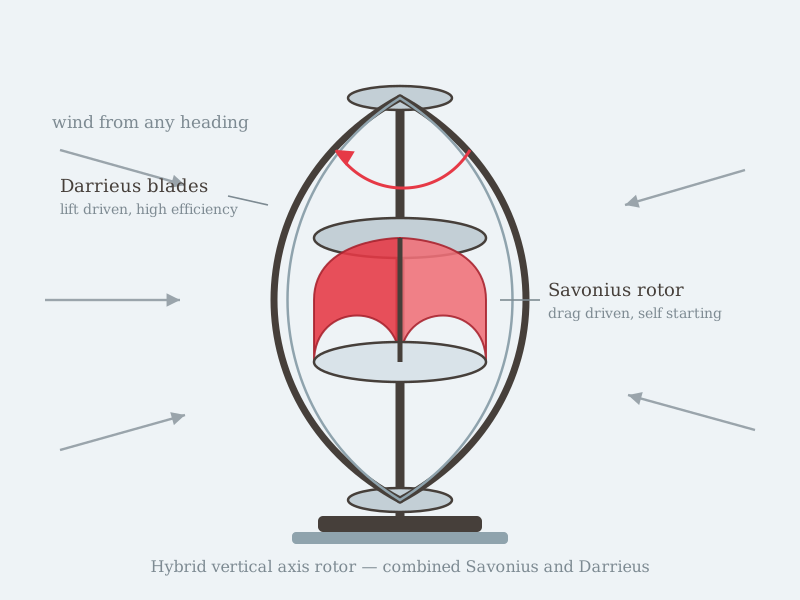
We designed turbines combining Savonius and Darrieus blades on a single rotor, which trades on the complementary weaknesses of each. A Savonius rotor is drag driven: it starts reliably at low wind speed but its efficiency ceiling is low. A Darrieus rotor is lift driven and considerably more efficient, but produces little starting torque and often will not self start at all. Putting them on a common shaft lets the Savonius section bring the rotor up to speed, at which point the Darrieus blades take over and carry the useful power.
The analysis used Computational Fluid Dynamics alongside numerical methods, examining the fluid–structure interaction and the energy conversion behaviour across several configurations. Getting meaningful results from a vertical axis rotor is harder than for a horizontal one: blade angle of attack changes continuously through every revolution, the downstream blades pass through the wake shed by the upstream ones, and the flow is unsteady by construction rather than by accident.
As team lead I divided the work across the group, kept the modelling assumptions consistent between us so results could actually be compared, and coordinated reporting to our supervisor. The project is where I first learned that a simulation is only as trustworthy as the assumptions behind it, and that the useful engineering output is usually a comparison between designs rather than an absolute number.